Resources for you and your business
Beyond the Seams: How to Spot “Red Flag” Quilt Tops During Intake
 Tracey Browning
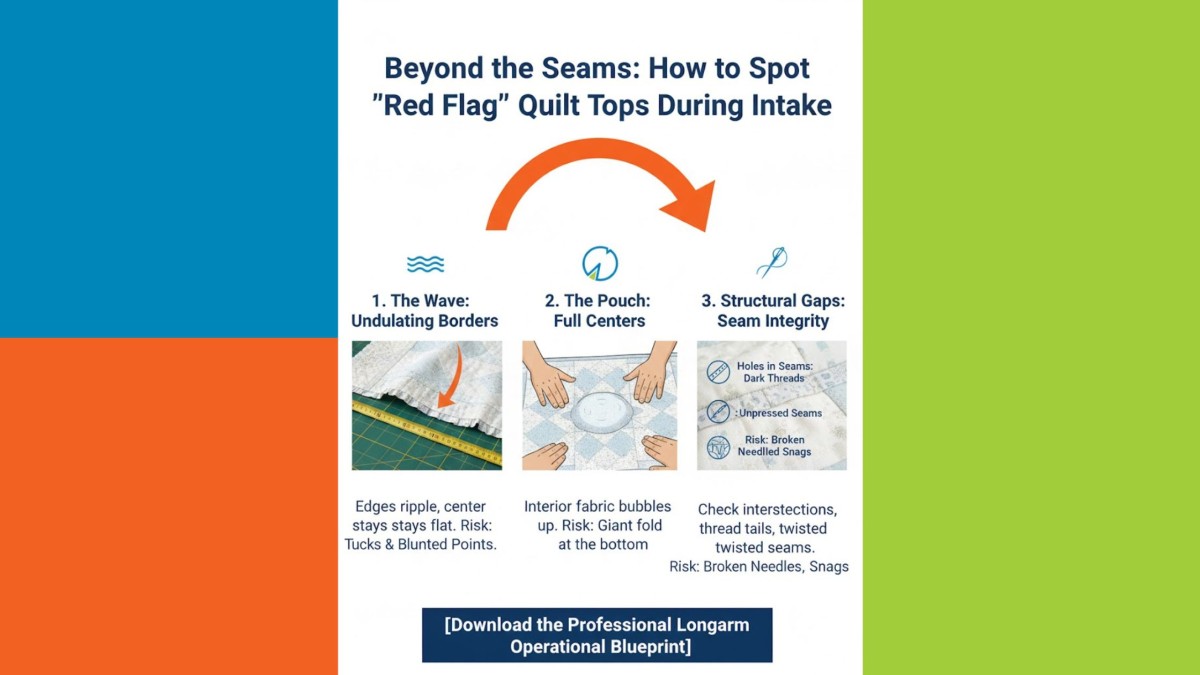
Here is how to spot the three most common "Red Flags" during intake and how to handle them like a pro.
Beyond the Seams: How to Spot “Red Flag” Quilt Tops During Intake
As a professional longarmer, there is a specific kind of sinking feeling that only happens at the frame. You’ve loaded the backing, centered the batting, and advanced the quilt top, only to realize that the borders are waving at you like the ocean or the center has enough “happy fabric” to create an accidental pleat.
At this point, you have two choices: spend hours of unbilled time trying to “quilt it out” with steam and starch, or deliver a finished project that doesn't meet your professional standards.
The secret to avoiding this dilemma isn’t found in a new quilting technique; it’s found in your Intake Process. By performing a physical audit before the quilt ever touches your rollers, you move from being an "order taker" to a Partner in Artistry.
Here is how to spot the three most common "Red Flags" during intake and how to handle them like a pro.
1. The Wave: Undulating Borders
Wavy borders occur when the border fabric is longer than the actual body of the quilt. This usually happens when a piecer sews long strips of fabric onto the edges and trims the excess, rather than measuring the quilt through the center and cutting the borders to fit.
How to spot it:
Lay the quilt top flat on a large table or a clean floor. If the edges of the quilt ripple or "ruffle" while the center stays flat, you have wavy borders.
OR I like to lay the quilt top centered over the front roller of my machine. Then physically fold/place the top border over the center to see if it is the same length. Repeat with the bottom border. Then turn the quilt top 90deg and repeat the process to determine if the side borders are the same length as the center measurement.
The Risk:
On a longarm, that extra fabric has to go somewhere. If it isn't eased in perfectly, it will result in "tucks" or blunted points.
NB: Gold members have access to an editable pdf handout to provide to customers on how to measure and attach their borders to avoid this 'red flag'. This flyer can be personalised to promote your own business logo and contact details to hand out to guild members as part of your marketing endeavours

2. The Pouch: Full Centers
A "full center" is the opposite of a wavy border. This is when the interior of the quilt has more surface area than the borders can contain.
How to spot it:
Lay the quilt flat and run your hands from the borders toward the middle. If the fabric "bubbles" up in the center—creating what look like small hills or pouches—the quilt is not square.
The Risk:
As you advance the quilt on the rollers, that fullness will migrate. By the time you reach the bottom third of the quilt, you may find yourself with a giant fold of fabric that simply cannot be quilted flat.
One snapshot shows you exactly where your time is disappearing. It gives you the "permission" you need to start charging for your expertise and the mechanical challenges you solve on the frame.
3. The Structural Gaps: Seam Integrity & Thread Shadows
Sometimes the red flags are smaller, but they can be just as damaging to the final result.
What to look for:
Holes in Seams:
Check the intersections where multiple blocks meet. If the stitching didn't quite catch, the tension of the longarm will pull those holes wide open.
Dark Thread Shadows:
If the piecer used dark fabrics but didn't trim the "tails" or seam allowances, those dark threads will show through the light-colored fabrics once the quilt is quilted and under a bright light.
Unpressed Seams:
Seams that are twisted or "nesty" create lumps that can break needles or cause the hopping foot to snag.
How to Have the "Red Flag" Conversation
Spotting a red flag isn't about criticizing the piecer; it's about managing expectations. When you find an issue, use your Intake Vault checklist to show the customer exactly what you are seeing.
Try saying this: "I noticed some fullness in the center here. Because the longarm applies even tension, this extra fabric might result in a small pleat to keep the quilt square. Would you like me to proceed as is, or would you like to take it back to adjust the seams?"
By identifying these issues early, you protect your reputation and ensure the customer knows exactly what the "mechanical reality" of their quilt will be.

Take Control of Your Intake
If you’re tired of "firefighting" fabric issues on the frame, it’s time to professionalize your process. Our Professional Longarm Operational Blueprint includes a comprehensive Intake Vault with a step-by-step physical audit checklist, quality release waivers, and prep one-sheets to send to your clients.
Stop guessing and start quilting with confidence. Download the Professional Longarm Operational Blueprint here to master your intake and protect your profit margins.
Gold Members:
This valuable tool is now available to you as a benefit of your membership. Please check your community where it is a pinned post for you to access NOW.
Don't forget you can also use the video search guide with keywords to find where we discuss any topic each month since Oct 2020.
Check out your Bonus Resources course to find premade helpful customer handouts that you can brand with your own business logo and information.



IQ Summit Facebook group
Have you joined our community here on Academy or on the FREE Facebook Group for IQ owners? Click on the Facebook icon to join in and see all the amazing designs that everyone has come up with already, building on what they have learned inside this membership. If you are a paid member of IQ Summit or the Gold Members group then we also have a private community inside this platform as well. You can find the link on the top of this page to explore the community you are enrolled in here.
Would you like to have more information at your fingertips to help you with your Longarm Business?
Then head on over to check out the Resources I’ve prepared for you. A really valuable article with a downloadable pdf is a Longarm troubleshooting checklist that everyone should print and use when having machine issues!
We discuss many relevant topics in our monthly live Q & A sessions where we all learn something new and useful each time. From these, courses and articles are created, to build out our library of resources for members to find and utilise when needed.
Then join us in the Gold Member Group of Machine Quilting Academy. If you are already a paying member of IQ Summit then contact me for a special discount voucher to sign up to this service.
